Why m640
The name requires an explanation — and the explanation is the model.
In the early 1980s, Sergey Bubka began setting world records at a pace the sport had never seen. By the time his career ended he had set 35 of them, dominating the event from 1983 to 2001 and raising the world record to 6.15m — a mark that stood for over 20 years until Renaud Lavillenie cleared 6.16m in Donetsk in 2014. Mondo Duplantis has since taken the record to 6.31m and is approaching the 6.40m mark that Bubka was reaching for. What most people saw in Bubka was an extraordinary athlete. What I saw — and what I have spent thirty years trying to understand and teach — was an extraordinary method.
On numerous occasions between 1991 and 1997, I witnessed Bubka in training and competition performing at levels approaching 6.40m. Not clearing it — approaching it. That number, 640 centimeters, became the target I believed the model was capable of producing — not a ceiling, but a height to be exceeded. It became the name.
"I called it m640 because I believed — and still believe — that a man can clear 6.40 meters. With a superior model that demands superior athleticism rather than adaptation to static physical input."
Armand Duplantis has now cleared 6.31m (20 feet, 8.4 inches) — the current world record, set in March 2026 — and continues to raise the bar. What I observe in his vaulting shows significant similarities with the m640 model — the same energy model, the same continuous chain, the same absence of the passive phases that constrain many. That alignment is not a coincidence. All methods and models begin to converge somewhere around 6.10m — at that level, passive phases simply cannot survive. What he does beyond that point is consistent with everything the m640 model predicts.
Where the model came from
In 1985 I was sitting with Vladimir Polyakov — the first Russian vaulter to clear 19 feet (WR 5.81m) — watching Bubka compete in Sochi in an early spring competition. Bubka won with something around 5.85m. Polyakov turned to me and said that Bubka's technique was irrational and unpolished — a helicopter, he called it, with blades swinging all over the place.
I remember my reply: it is not the cleanliness of the lines that counts, but the height over the bar.
That exchange catalyzed something. I could see clearly, for the first time, that Bubka was doing something completely different from everything the sport had produced before. More athletic in raw physical terms — powerful, explosive — but not technically refined by conventional standards. What set him apart was something else entirely. I began what I came to think of as the reverse engineering of Bubka's formula — trying to extract the principles beneath the performance.
Sochi was the center of the USSR national training base. I was immersed in that environment — surrounded by the country's best vaulters and coaches, consuming information from every direction. Being coached by Anatoly Gordienko from 1979 to 1987, who had a very original understanding of certain elements of the vault. Listening to comments from Vitaly Petrov. Absorbing the theoretical work of Viktor Mikhailovich Yagodin — head coach of the USSR national pole vault team and one of the leading theoreticians of the Soviet school. Watching elite athletes daily. Reading everything available including the foundational literature on the event. Being part of the USSR Junior and then Russian national roster, with full exposure to the latest thinking at the highest level of the sport.
By the late 1980s, while being coached by Yuri Volkov, I had identified the main ingredients. The continuous chain of energy input. The absence of passive phases. The athlete as the engine, not the pole. The objective identical to the rigid pole era — get off the pole as fast as possible — with a better instrument now available to amplify the output.
Coming to Australia in 1991, I finished runner-up to my good friend Simon Arkell in the Australian Open Championship, and began working with Alan Launder in Adelaide. Alan — a dedicated student of the event and one of the sharpest coaching minds I have encountered — encouraged me to continue developing the model and to coach. It was there, working with Alan's group and preparing athletes for the 1992 Barcelona Games, that the model took its first real coaching form.
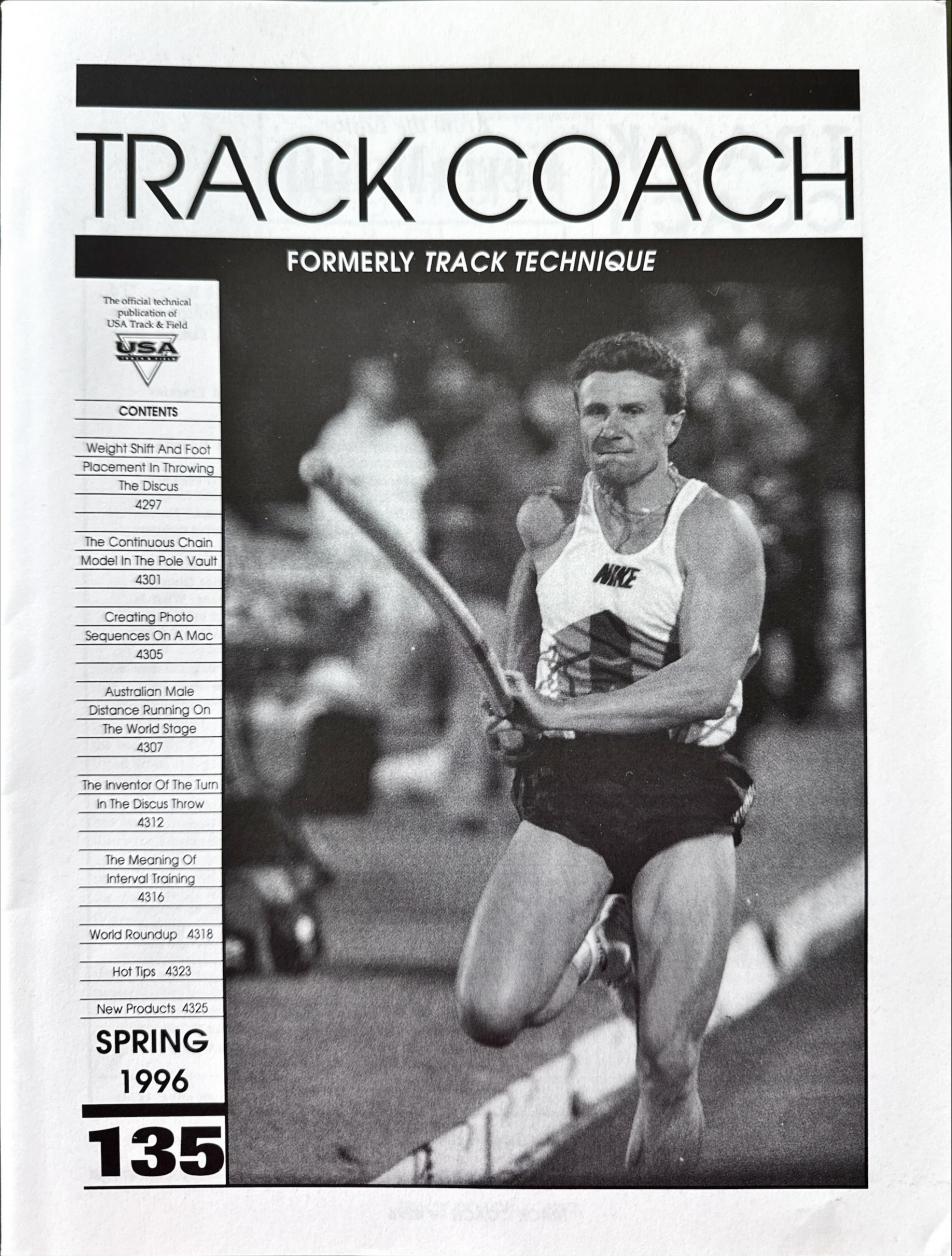
In 1996, this thinking reached print for the first time.
"The Continuous Chain Model in the Pole Vault"
Track Coach No. 135, Spring 1996, pp. 4301–4304.
The terms introduced there — continuous chain, active and passive phases — are the same ones anchoring the Definitions index today. This is the earliest published record of the model, three decades before this website.
The article uses inversion in relation to rock-back for the first time in print — the model has since settled on inversion as the standard term, refined over three decades but unchanged at its core.
The model in practice
Since arriving in the United States in 1992, the model has been tested, refined, and proven across four decades of coaching at every level — from high school state champions to Olympic medalists.
Jeff Trembley improved from 3.00m to 4.87m under the model, becoming a two-time Tennessee High School State Champion and State Record Holder.
Richardo Diaz vaulted 5.20m at Missouri Valley College under the m640 model — an NAIA-level result that demonstrated the model's effectiveness at the collegiate level from the earliest years of coaching.
Tori Gaul began pole vaulting from scratch at Carson-Newman University in 2017. Under the m640 model she reached 3.97m in under two years — earning All-American honors and setting the school record.
The clearest proof of concept is Lawrence Johnson. Six consecutive US national titles, a World Indoor Silver in 1997, a World Indoor Gold in 2001, an Olympic Silver in Sydney in 2000, and the American Indoor Record — set in 2001 and held for years — all produced under the m640 model, from the first session to the last.
Angela Rummans improved from 4.00m to 4.40m in ten months under the model — a 40 centimeter gain that qualified her for the 2012 US Olympic Trials at age twenty.
Katie Moon — Katie Nageotte at the time — vaulted under the m640 model from 2013 to 2017, improving from 4.44m to 4.65m during her development phase. She went on to win Olympic Gold in Tokyo 2021 and Olympic Silver in Paris 2024 under her primary coach Brad Walker.
In 1991–1992, working as assistant to Alan Launder in Adelaide, I coached Simon Arkell and Dean Smith — both members of the Australian team at the 1992 Barcelona Olympic Games.
The foundational article presenting the m640 model was published on Pole Vault Power in 2005. It accumulated over 100,000 views and remains in circulation today. The terminology it introduced — free takeoff, inversion, time on pole, continuous chain, active and passive phases — is now standard vocabulary in pole vault coaching worldwide.
Who this model is for
The model has no floor and no ceiling. A beginner can be introduced to it on their first day, because there is nothing to unlearn. An elite vaulter competing at the highest level, using any established technique, can benefit from it too, without discarding what already works.
The shift toward m640 is organic and gradual, not a decision made once and imposed all at once. Any movement in the direction of the model produces positive results — a coach does not need to commit an athlete to a wholesale change to see positive results.
For elite vaulters, the shift rarely happens through deliberate overhaul of an existing technique. It happens by expanding the athlete's library of movements — introducing new options rather than replacing old ones by decree. The athlete's own body organically decides what to keep.
Who I coach — and who I don't
I work with high school athletes, club vaulters, masters athletes, international athletes, and coaches at all levels. The m640 model is complete enough to serve a beginner on their first day and deep enough that the world's best vaulters have not exhausted it.
I do not work with current college athletes who have an active program coach. The model works alongside programs — not around them. College programs are potential institutional partners, not competitors.
The model did not develop in isolation. These are the people whose influence shaped it.
The model is here. The work continues.
Explore the m640 Model